Why standardize?
“I already have a system going. Why change?”
When we all “speak the same language” when using certain tech, we can avoid confusion.
There are, of course, many obvious benefits of diversity. As the saying goes, “There is more than one way to skin a cat.” But also… “less is more“!
Typically, standards do not benefit from dozens of variations.
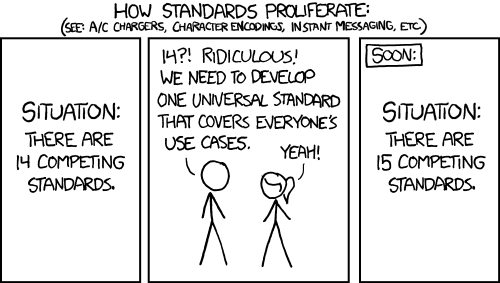
Mouse-over (hidden) caption: “Fortunately, the charging one has been solved now that we’ve all standardized on mini-USB. Or is it micro-USB? Shit.”
Ironically, mobile phone manufacturers (including Apple!) seem to have settled on USB-C. It only took them until the iPhone 15 (2023-September), about 12 years after this comic.
The cost of confusion
Hundreds of millions.
For practical examples, specifically US customary vs. metric, take a glance at NIST’s article on this topic. For instance, NASA’s Mars Climate Orbiter sunk a third of a billion USD, way back in 1998!
Metric
The largest example?
Standardization in the sciences is critical. Most would consider metric the most feasible, especially due to its widespread acceptance, globally.
Did you know: until 2019, the kilogram (and by extension the US pound!) could only be defined by referencing an old 1 kg weight, secured in a vault near Paris? Yeah, pretty inconvenient.
The 2019 redefinition relies on the Kibble balance, a piece of equipment that did not exist with enough precision until the 1990s or later.
Full scale metrication efforts in the US have been abandoned for decades. However, some industries and agencies (including NASA) have made the switch.
More standards!
Physical measurements, like when using a meter stick, are not the only thing that may be standardized.
Here are a list of standards I find helpful or interesting. How much you end up using them likely depends on your line of work, hobbies, and so on. (I anticipate expanding this list over time.)
- Spelling alphabets
- English/Latin
- ICAO or NATO Phonetic Alphabet (link). Modern form circa 1956.
- Used globally, even outside of NATO, by pilots, call centers, militaries, and civilians alike.
- ICAO or NATO Phonetic Alphabet (link). Modern form circa 1956.
- Spelling alphabets also exist for other languages, and completely different writing scripts! For example, check out the Russian Spelling Alphabet.
- Instead of Alpha, Bravo, Charlie… it starts with Anna, Boris, Vasily.
- English/Latin
- Time
- Length of time, or time interval
- The second, part of the International System of Units (SI)
- Point in time, or instant
- Timekeeping: UTC
- Representation in text: varies by country
- ISO 8601 recommends YYYY-MM-DD, which I typically use on this website.
- As of 2025, it’s not commonly used in the US, except in technical circles such as programming.
- ISO 8601 recommends YYYY-MM-DD, which I typically use on this website.
- Representation for programming: Unix Time (link)
- This (literally!) counts the number of seconds since 1970-Jan-01 at 00:00:00 UTC.
- On most implementations, the “smallest” value (the “zero” on the meter stick) is 1901-Dec-13.
- The largest value is 2038-Jan-19 at 03:14:07 UTC.
- Unless a new / updated standard is adopted, one second later, this value will “overflow” like an old fashioned odometer resetting to all zeros.
- This is called the Year 2038 problem, and may break a lot of computer programs, including software, or calculations within Excel spreadsheets used by accountants.
- Analogy: Imagine that all calculators suddenly agreed that 2 + 2 = 5. Math class would be impossible without fixing every calculator.
- However, we’ve overcome this problem before! The Y2K problem – a nightmare for programmers, hardly a bother for anyone else, occurred when the date rolled from 1999-Dec-31 to 2000-Jan-01. Because many programs stored the year as two digits (’99), the reset to “00” was expected to cause chaos. Nowadays the year is often stored with four digits (2000), so at least in this niche, there’s nothing to worry about for another 8 millennia.
- Unless a new / updated standard is adopted, one second later, this value will “overflow” like an old fashioned odometer resetting to all zeros.
- This (literally!) counts the number of seconds since 1970-Jan-01 at 00:00:00 UTC.
- Length of time, or time interval